



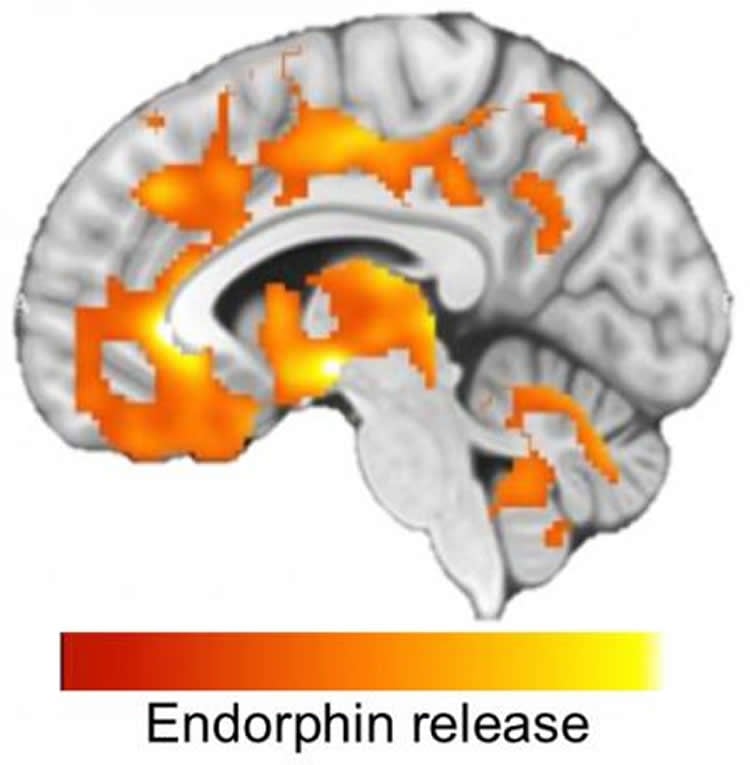
Summary: A PET neuroimaging study reveals high intensity impact training significantly increases endorphin release in brain areas associated with controlling emotion and pain.
Source: University of Turku.
Finnish researchers at the University of Turku have revealed that exercise-induced endorphin release in the brain depends on the intensity of the exercise. Endorphin release induced by exercise may be an important mechanism which affects exercise motivation and maintenance of regular physical activity.
A recent study conducted at Turku PET Centre, University of Turku, shows that the popular high-intensity interval training (HIIT) leads to endorphin release in the brain, which might alleviate the physical and emotional stress caused by the high-intensity exercise. A less demanding, traditional one-hour aerobic exercise does not cause similar endorphin release.
In the study, HIIT significantly increased the release of endorphins and other opioid peptides in the brain areas controlling pain and emotions. In addition, HIIT induced negative feelings in the test subjects, which was associated with higher endorphin release. Although one-hour aerobic exercise did not induce significant release of endorphins, it increased pleasurable feelings and euphoria, which correlated with endorphin release.
“Our results highlight that exercise intensity affects endorphin release and that the brain opioid system is involved in both positive and negative feelings caused by physical exercise performed at different intensities,” says Doctoral Candidate Tiina Saanijoki from Turku PET Centre.
“Exercise-induced endorphin release may be an important mechanism which supports exercise motivation and maintenance of regular exercise. At moderate training intensities, the pleasurable sensations caused by the possible release of endorphins may promote habitual exercise. At very high exercise intensities the release of endorphins appears to be linked to increased negative feelings and pain, and may be needed to manage the emotionally and physically demanding challenge. However, such negative feelings may discourage further exercise. Exercise intensity should be taken into account when starting new exercise routines,” explains Saanijoki.
The study was conducted using positron emission tomography (PET). The participants were injected with a radioactive compound which binds to their brain’s opioid receptors. Radioactivity in the brain was measured with the PET scanner in three conditions: after a 60-min aerobic moderate-intensity exercise session, after a high-intensity interval training (HIIT) session, and after rest.
Funding: The research was funded by the Academy of Finland, the Hospital District of Southwest Finland, the University of Turku, the Ministry of Education of the State of Finland, the Paavo Nurmi Foundation, the Novo Nordisk Foundation, the Paulo Foundation, the Finnish Cultural Foundation, the Instrumentarium Science Foundation, and the Juho Vainio Foundation.
Source: Tiina Saanijoki – University of Turku
Image Source: NeuroscienceNews.com image is credited to Turku PET Centre.
Original Research: Abstract for “Opioid Release after High-Intensity Interval Training in Healthy Human Subjects” by Tiina Saanijoki, Lauri Tuominen, Jetro J Tuulari, Lauri Nummenmaa, Eveliina Arponen, Kari Kalliokoski & Jussi Hirvonen in Neuropsychopharmacology. Published online July 19 2017 doi:10.1038/npp.2017.148
[cbtabs][cbtab title=”MLA”]University of Turku “High Intensity Interval Training Releases Endorphins in the Brain.” NeuroscienceNews. NeuroscienceNews, 24 August 2017.
<https://neurosciencenews.com/hiit-endorphins-7365/>.[/cbtab][cbtab title=”APA”]University of Turku (2017, August 24). High Intensity Interval Training Releases Endorphins in the Brain. NeuroscienceNew. Retrieved August 24, 2017 from https://neurosciencenews.com/hiit-endorphins-7365/[/cbtab][cbtab title=”Chicago”]University of Turku “High Intensity Interval Training Releases Endorphins in the Brain.” https://neurosciencenews.com/hiit-endorphins-7365/ (accessed August 24, 2017).[/cbtab][/cbtabs]
Abstract
Opioid Release after High-Intensity Interval Training in Healthy Human Subjects
Central opioidergic mechanisms may modulate the positive effects of physical exercise such as mood elevation and stress reduction. How exercise intensity and concomitant effective changes affect central opioidergic responses is unknown. We studied the effects of acute physical exercise on the cerebral μ-opioid receptors (MOR) of 22 healthy recreationally active males using positron emission tomography (PET) and the MOR-selective radioligand [11C]carfentanil. MOR binding was measured in three conditions on separate days: after a 60-min aerobic moderate-intensity exercise session, after a high-intensity interval training (HIIT) session, and after rest. Mood was measured repeatedly throughout the experiment. HIIT significantly decreased MOR binding selectively in the frontolimbic regions involved in pain, reward, and emotional processing (thalamus, insula, orbitofrontal cortex, hippocampus, and anterior cingulate cortex). Decreased binding correlated with increased negative emotionality. Moderate-intensity exercise did not change MOR binding, although increased euphoria correlated with decreased receptor binding. These observations, consistent with endogenous opioid release, highlight the role of the μ-opioid system in mediating affective responses to high-intensity training as opposed to recreational moderate physical exercise.
“Opioid Release after High-Intensity Interval Training in Healthy Human Subjects” by Tiina Saanijoki, Lauri Tuominen, Jetro J Tuulari, Lauri Nummenmaa, Eveliina Arponen, Kari Kalliokoski & Jussi Hirvonen in Neuropsychopharmacology. Published online July 19 2017 doi:10.1038/npp.2017.148